What Makes a Great Aerial Teacher?
- Sara | WakefulAscent

- Nov 26, 2025
- 5 min read
Updated: Jan 2
Gone are the days of any prevailing belief that the best aerial teachers are the strongest, bendiest, or most advanced performers.

Culturally, acceptance has grown that being amazing at aerial does not translate to being an amazing teacher. Indeed, those are two VERY different skill sets! Skilled aerialists can sometimes run into limitations because they have a harder time relating to the struggles of their students (hint - your non dominant side is excellent for this). Some of the best teachers are the ones who, as a student, had to ask for help more times than they ever wanted to, felt like they didn't fit in, or felt like they were ungraceful, weak, or a slow learner. Not required, but not uncommon. Experience itself is one of the #1 factors for being a great aerial teacher, because experience exposes you to the realities of the aerial classroom. But it is not the only factor, and it is possible to have tons of "experience" without learning from it.
Teaching aerial arts is not as much about being good at what you're teaching as it is about being good at teaching. And knowing your shit. Let's talk about it.
Here are the qualities that actually matter (and why they’re far more important than elite skills).
1. Patience that doesn’t crack under repetition
Teaching aerial is a LOT of repeating yourself in new ways.
Beginners will:
Forget which leg is which,
Wrap backward,
Freeze and stop being able to listen to instructions
Get tangled
Mishear you
Misinterpret you
and sometimes do the exact opposite of what you said.
If you can recognize all of that as normal and your nervous system can stay regulated through all of that…you are already in a really good place.
Patience is a safety rail. Patience is a leadership quality. Patience is a relationship tool.
And it’s something that can absolutely be developed with practice, regardless of your personality.
2. A deep respect for safety and boundaries
A great aerial teacher has a healthy relationship with risk. They are not catastrophizing everything, but they are aware of what could go wrong.
They:
Scan the room constantly
Spot patterns before they become problems
Teach strong foundations, rest positions, exits, and safety protocols.
Communicate boundaries clearly
Aren't afraid to communicate when a student needs to stop, slow down, or regress
Students feel safe with them, and safety unlocks learning.
3. The ability to communicate one idea in 10 different ways
Aerialists learn through:
Visuals
Repetition
Talking it out
Imagery
Tactile cues
Floor drills
Metaphors
Hand gestures/charades
A great teacher can switch methods without shame or irritation.
If one cue doesn’t land, they don’t take it personally, they just try another. Also, sometimes the best cue, is no cue. Sometimes the student just needs more time to feel it in their body.

Curious about teaching or want to take your practice deeper? Join this masterclass on Empowered Aerial Teaching.
4. Emotional steadiness (even when a student is dysregulated)
Aerial classes are full of all kinds of emotions. Among the challenging ones are:
Fear
Frustration
Overwhelm
Embarrassment
Perfectionism
Self-doubt
Aerial arts is inherently vulnerable. It contains risks and it requires a lot of emotional strength to be willing to fail at something multiple times in a row.
A great teacher doesn’t amplify the emotion. They absorb it, transform it, and send back the antidote.
When the teacher can establish the class as a safe place to experiment, struggle, and succeed - this is what makes a class feel safe even when the material is challenging.

5. Sense of Humor
I've said it before and I'll say it again - a sense of humor is a huge asset for an aerial teacher. Aerial is hard, teaching aerial arts is hard, but struggles and failures can turn into the funniest, most joyful moment of someone's day. This makes learning far more sustainable and attractive to students, and far more fun for the teacher.
6. The desire to keep learning
The best aerial teachers:
Take trainings
Ask questions
Experiment
Analyze their own technique
Update their methods
Aerial isn’t static. It's a young and continually evolving art form. We all have the opportunity to grow with no end in sight, which is part of what makes it so fun.
7. A clear internal compass about what is and isn’t appropriate and the leadership skills to make decisions
This includes knowing:
When a student is not ready
When a skill is too complex
When someone needs to come down
When to soften or push
When to shift the plan
When to say no
This judgment and the confidence to implement it takes time to develop, but everyone can get good at this.
8. An understanding of how learning works
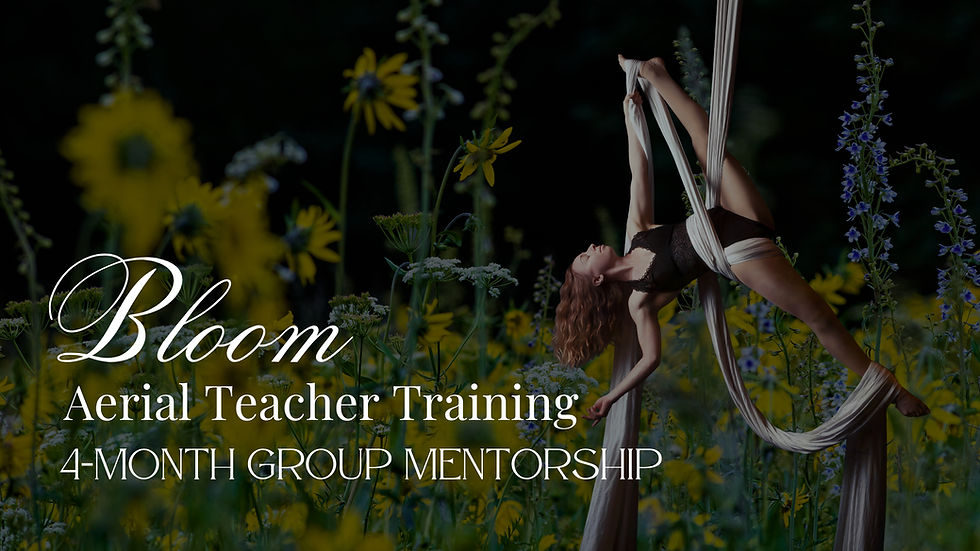
Teaching aerial arts is not about having some exclusive list of skills and cues. This would never suffice because it doesn't tell you anything about how information is actually processed. Something that I find makes aerial teaching so engaging and rewarding is that students are so different. Something works for one but not another. Something works one day but not the next. It keeps us creative! It's also why formulas will never provide what you need to excel as a teacher. Understanding how learning actually happens in the brain and what to watch for allows you to assess and shift your strategy on the spot. This is huge, and a good aerial teacher training will guide you in this direction. We directly explore this in the Wakeful Ascent BLOOM Aerial Teacher training.
9. Nervous system literacy
Aerial arts are highly nervous system intensive. Students may be navigating fear of heights, trying new things, physical challenges, social fears, self-doubt, body awareness changes, and internal or external pressures.

10. A LOVE for aerial arts.
Teaching aerial can be very challenging. Running a program or studio even more so. Learning aerial arts is also challenging. When you have a deep love for aerial, it does 2 things:
1) It helps you get through the rough patches
2) It oozes out of you into your students, inspiring them and motivating them to move through the challenges as well.
When things get hard, or confusing, or self-doubt creeps in, a LOVE of aerial is the medicine that helps you move through it.
If you’re reading this thinking, “oh… that actually sounds like me” or "that's what I want for myself!" …but you're not an aerial teacher yet...

Then you’re closer to ready than you
think.
If you want to explore whether teaching is a path for you, you can download:
✨ Becoming an Aerial Teacher Workbook ✨A self-assessment for anyone exploring the path of teaching aerial arts.