Fear of Drops in Aerial Arts: When to Push Through and when to Step Back
- Sara | WakefulAscent

- Jan 13
- 3 min read

Fear of drops is one of the most common concerns in all of aerial - especially aerial silks. Fear around drops is normal, expected, and healthy - most brains have (valid) concerns about being at height.
Whether your fear of the drop is justified or not really the question (unless there's a genuine risk to physical safety due to lack of knowledge or proper rigging / adequate height).
For our purposes, let's assume it IS physically safe and the teacher has made this thoroughly clear. In this case, how should we handle fear?
The answer is not always to push through, even when it's safe. The reason is neurological.
1. Signs to do an aerial drop, and signs to hold off
Signs to move forward with the drop: Your fear is mild-moderate
You feel curious, giggly, or a little excited Not physically shaking Not freezing You have full control of your body - grip, engagement, positioning You can think clearly, process your teacher's cues, and ask questions if you have them These are positive indicators that your fear is not overwhelming your physical capacity or your ability to reason. In this case, dropping may very well lead to a breakthrough, an embodied realization that the drop is safe, and a feeling of accomplishment.
Feeling scared on its own is not an indicator that you shouldn't do a drop, unless that feeling is intense.
If on the other hand you feel: Overwhelmed by fear Freezing or losing motor skill capacity Unable to process your teacher's cues Unable to think coherently Unable to verbalize questions
Shaking
Movements becoming inaccurate and uncoordinated
These conditions compromise your safety and emotional well-being and are signs to: not begin wrapping, to stop wrapping, or to unwrap and carefully walk the drop down if you have already wrapped. It doesn't mean you can never do the drop, it just means you need more time, support, or a different approach.

Check in with yourself (or your student) after the drop
What happens after the drop is one of the most important data points to understand if we made the right choice.
If you went through with the drop and land feeling relief, excitement, giggles, or pride, your nervous system updates its story:
“Oh. That wasn’t dangerous. I can do this.”
This is where confidence grows.The drop becomes meaningful, embodied information - not just a skill, but a reframed experience. Dropping was the right choice and can be repeated as long as the student still feels centered. (Avoid lots of drops for new students as it becomes exhausting for the nervous system).
Let's say on the other hand you were feeling okay, or maybe trying to cover up your fear, and you do the drop - at the end, you feel rattled, freaked out, stiff, or upset. When this happens, your brain reinforces the idea that the drop is scary and might be dangerous. This experience is also hard on you emotionally.
The nervous system doesn’t learn courage.It learns:
“I was right. That was dangerous.”
This makes future drops harder, not easier. In this case, dropping was not the best choice - but we don't always know until we try. If this happens, don't force yourself to try again unless you genuinely feel calm and comfortable.
The Takeaway
Productive fear resolves into relief or joy.
Too much fear resolves into panic or shutdown.
The difference matters neurologically, pedagogically, and emotionally.
Navigating fear of drops is not about forcing our way through, but about letting the brain and body establish a reasonable amount of safety.

For teachers: how do you know when to push and when to pull back?
Check the lists for signs that the student is in good space to drop or is becoming dysregulated. Always communicate to students that they have a choice - they don't HAVE to do the drop, and they can change their mind. Teach unwrapping and/or walk-downs so student's can decide at any point. Teach the wrap close to the ground so students don't have to manage fear and new information all at once.
Understand the difference between support and pressure - the former can quickly and easily turn into the latter. If you make a mistake - acknowledge and move forward in a supportive way. We cannot always be sure when it is right to push and when to instruct the student to come down, if they are not deciding for themself.
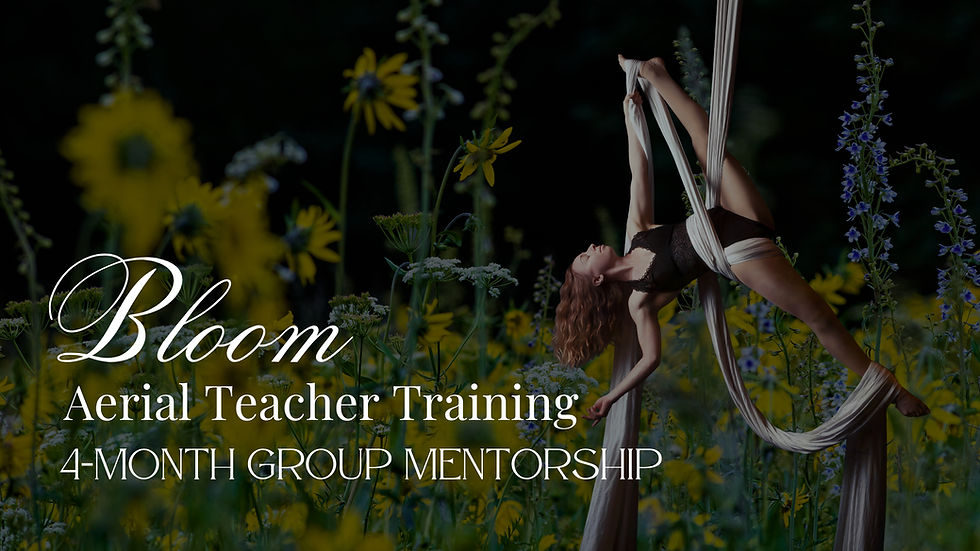
If this is the kind of depth of knowledge you crave as an aerial instructor, the BLOOM Aerial Teacher Training is made for you.