Why Aerial Teacher Training Must Go Beyond the Tricks
- Sara | WakefulAscent

- Feb 25
- 5 min read
There’s a common assumption in the aerial world:
If you can do the trick, you can teach the trick.
And if you know enough tricks, you’re ready to teach.
But advanced skills and even skill breakdowns, good warmups, and clever techniques are not the same as pedagogy - and it's not what makes great teaching.
And aerial arts are very high risk with real consequences when teachers are untrained (for obvious and non-obvious reasons).
Aerial teacher training that focuses primarily on skill breakdown and specific cues for skills may create teachers who can demonstrate…but not necessarily truly teach.
If we want teaching that reaches the many layers of the students — not just a collection of cool skills — we have to go deeper.
1. Demonstration Is Not Instruction
Being able to perform a skill does not automatically mean you understand:
How to curate a learning environment
How to work with different bodies and learning styles
When to give certain cues, when to be quite (and why)
How to troubleshoot on the fly
Why some students look “floppy” despite being strong
How to coach students ethically through pain and fear
How to navigate consent
How to design classes that build their own momentum
How to shape the values and culture of your program or studio
How to assess shoulder engagement and alignment
How to prevent safety beyond good rigging, mats, and warmups
How to spot, cue, and build progressions effectively
Why "spin slower" is actually bad advice for dizzy and nauseous students
Most teachers were trained in an apprenticeship model: “Watch me. Copy me. Try again.”
Or experience a week-long training that covers a few basics of teaching using specific skills as case studies.
But without understanding explicit vs. implicit learning, attentional focus, proprioceptive mapping, and how to teach body awareness, teachers often end up repeating cues that don’t change anything.
Teaching is deeply layered, and being prepared to teach requires more than a week or two of training.
2. Nervous Systems Are Ruling the Room — And Aerial Teacher Training Needs to Talk About That
Every aerial class contains students with:
Different threat responses
Different tolerance for inversion
Different trauma histories
Different stress loads
Different confidence baselines
Yet most teacher trainings barely mention nervous system dynamics.
If a student freezes before a drop…If someone starts to rush…If a beginner chronically under-engages…If an advanced student pushes recklessly…
Understanding the nervous system helps us to make the kinds of decisions that support the student, not just deal with the situation.
A teacher who understands regulation, co-regulation, and how to create balanced room energy prevents injuries and accelerates learning.
3. Strength Is Not the Same as Organization
One of the biggest blind spots in aerial instruction is assuming that messy movement is simply a strength or technique issue.
But often it’s not.
It’s:
Untrained proprioception
Weak body mapping
Lack of eccentric control
Not knowing how to organize limbs, joints, and muscles for efficient movement
Hypermobility
Stress
If we don’t slow down to teach body awareness as its own layer of learning, students may spend years reinforcing inefficient patterns.
When teacher trainings skip this layer, they create instructors who know progressions but not precision.
4. Safety Is More Than Spotting
Spotting and hands-on assists are often over-emphasized in aerial teaching. What aerial teachers really need is:
How to prioritize student autonomy
Principles for placements
Consent frameworks
Understanding when contact supports vs distracts
Using good judgment
Relational layers of spotting/hands-on assists
Without a closer look at the "between the lines" of spotting, teachers end up lifting students into poses, distracting when they mean to help, accidentally making students uncomfortable, and putting themselves in the way of danger.
5. Leadership Shapes the Entire Culture of a Studio
Aerial teachers are not just technicians.They are managing a dynamic, complex room full of people.
Their boundaries, presence, posture, and tone determines whether:
Students feel empowered or dependent
The room is balanced, sluggish, or hyperactive
Students become regulated or dysregulated
Class can run smoothly
Leadership is about building trust, creating safety and clarity, boundaries, and co-regulation.
And almost no one explicitly teaches that.
6. In an Unregulated Industry, Excellence is a Choice
Yoga has standards. Pilates has standards. Physical therapy has standards.
Aerial arts has not taken this step.
If we want:
Higher retention
Fewer injuries
Stronger professional credibility
More sustainable careers
Students who don’t plateau after intermediate
Then aerial teacher training must go beyond trick libraries.
It must include:
Movement science
Nervous system literacy
Technical precision
Leadership development
Ethical frameworks
Teaching methodology
Not as extras but as foundations.
What “Beyond the Tricks” Really Means
It means training aerial teachers to understand the many layers of learning, including the unseen parts. Teachers who can help a student feel into their body, curate a great learning environment, It means creating educators, not just instructors who can pass on skills.
And that shift changes everything.
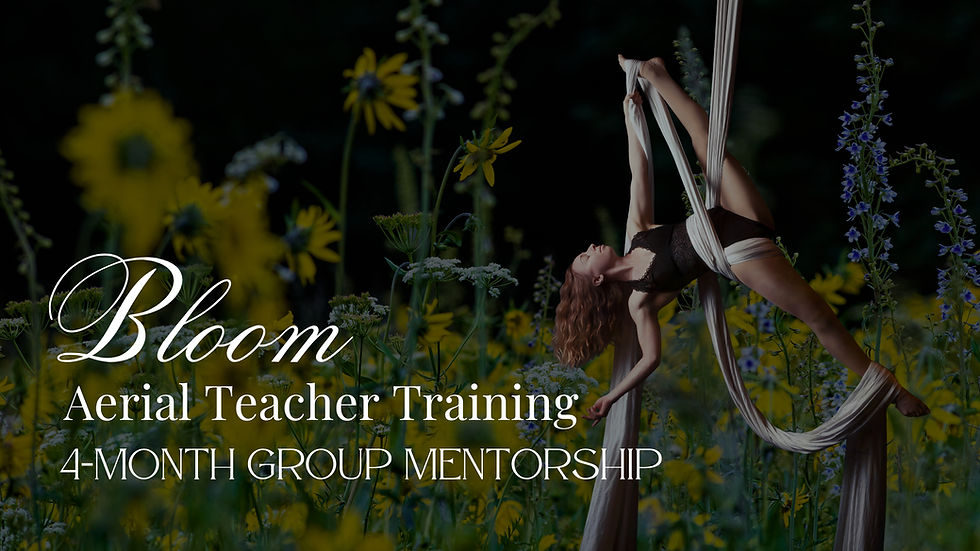
Where the BLOOM Aerial Teacher Training Is Different
BLOOM was built in response to this exact gap.
It is not a trick curriculum certification.
It is a 4-month comprehensive aerial teacher training designed to develop informed, confident, high-standard educators.
Inside the BLOOM Aerial Teacher Training we go beyond “how to do the skill” and into:
Movement science foundations — so you understand what you are looking at and make intentional decisions about cues, spots, and modifications
Nervous system literacy — so you can recognize freeze, shutdown, overdrive, and build real regulation in your classes - know how to actually support students in drops
Body awareness & proprioception training — so students don’t spend years reinforcing disorganized patterns and training at an elevated risk for injury
Principles for consent, spotting, and cueing — so you can analyze and decide, not memorize a handful of scenarios
Technical precision & progression design — so the details aren't overlooked
Leadership & room dynamics — so your presence builds autonomy, trust, and clarity, you can manage mixed levels, you know how to command the room
Scenario Play — so you have a clear plan of action when something doesn't go as planned
You keep the materials for life. They are continually updated. Because the goal is teaching that EVOLVES, and supporting you over the long term.
The BLOOM Aerial Teacher Training is a serious program for aerialists who don’t just want to deliver a trick curriculum. This aerial teacher certification takes place online with an in-person option. It uses case studies in aerial silks, aerial hoop, and aerial hammock, though the course, in not being trick-focused, can be applied to other apparatuses.
It’s for teachers who want to understand what they’re doing at a deeper level, lead, and raise the standard of the industry while they’re at it. Learn more about the BLOOM Aerial Teacher Training here